CASE STUDY · PHTN.AI
When an AI agent acts inside a bank, who decided, and can anyone prove it?
0 to 1 Agentic Platform for Automating Complex Workflows
How I turned an engineer built agent platform from showing everything into one that tells people what to do next.
Photon · digital engineering since 2007 · 8,500+ engineers · financial services, retail, pharma and healthcare
phtn.ai · Photon's enterprise agent platform · launch client: a global tier 1 bank
WHO I WORK FOR · PHOTON
Photon builds digital products for some of the world's biggest brands. phtn.ai is its agent platform.
2007
founded
8,500+
engineers
40%
of the Fortune 100 as clients
Strategy, experience and engineering for financial services, retail, consumer goods, restaurants, pharma and healthcare.
SOME OF PHOTON'S CLIENTS

01 · CONTEXT
One platform, three jobs, and a bank as the first customer.
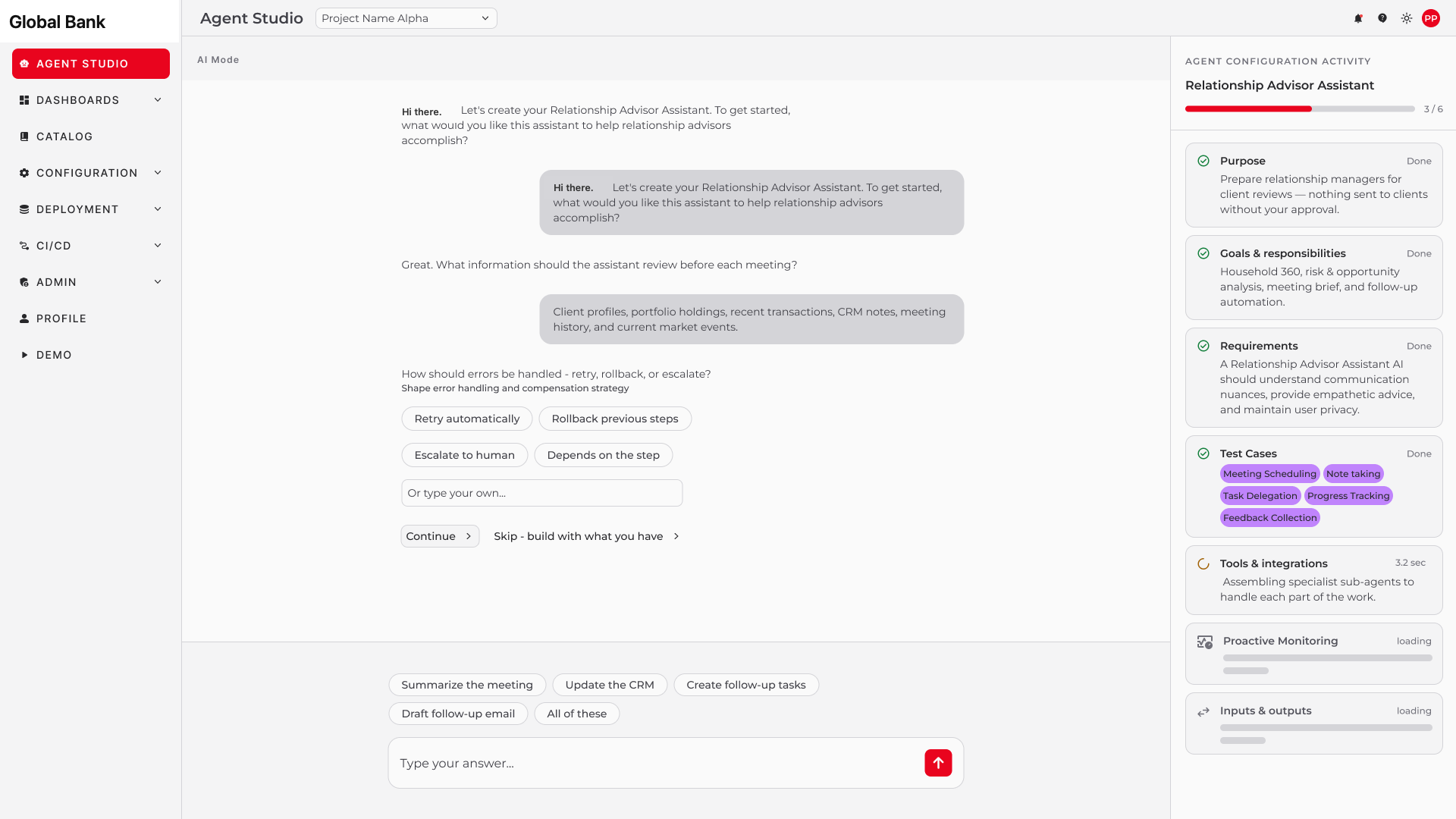
Agent Studio · My design
Build an agent from a plain description.
I work directly with the CTO, founders and VP of Product, in a culture where engineering leads. The job: find where design can shape direction, not just carry it out.
Agent Management · My focus
Govern, monitor and scale every agent.
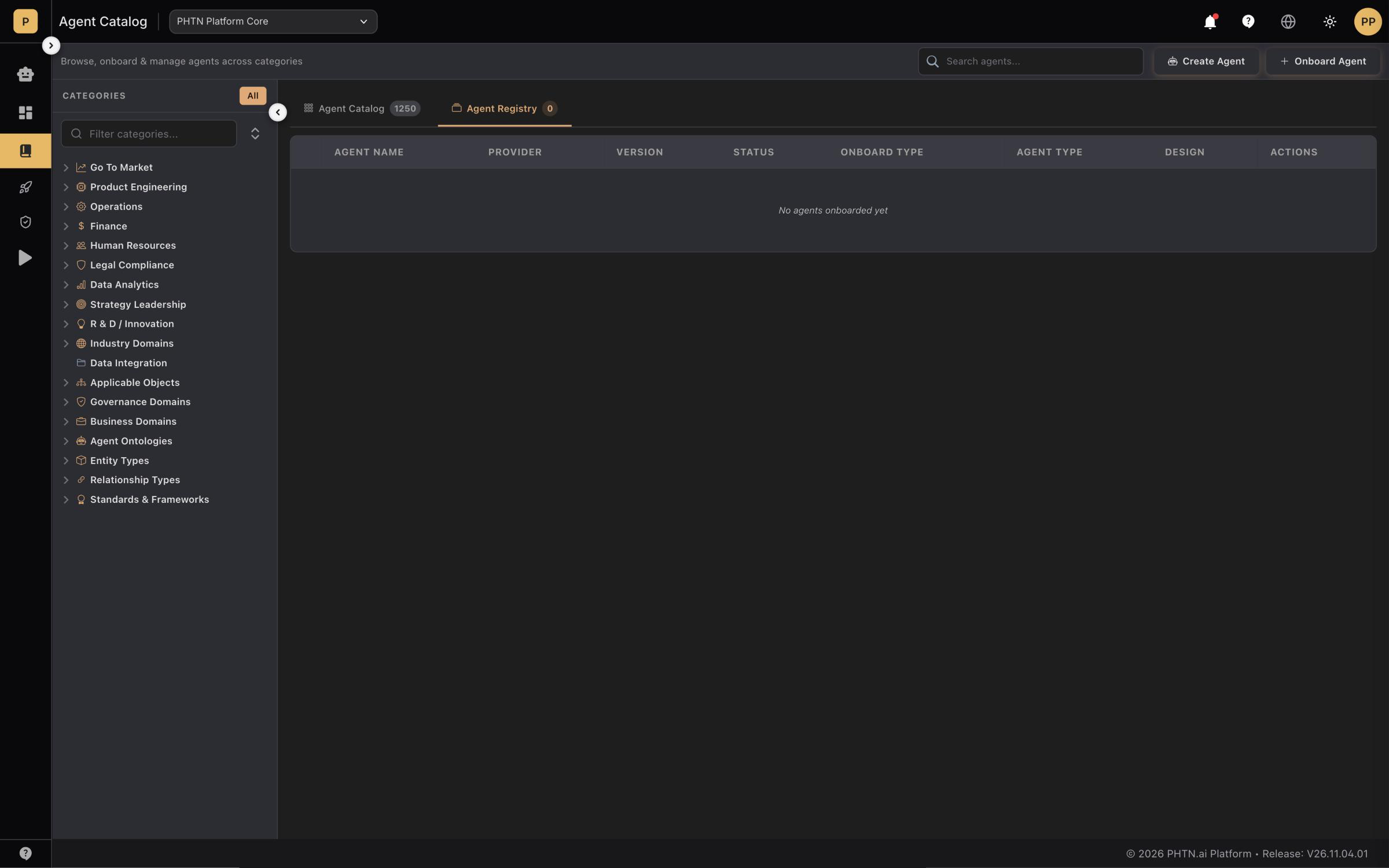
Agent Marketplace
Reuse agents instead of rebuilding them.
I inherited a prototype that showed everything and said nothing.
53 dashboard modules across AIOps, TechOps and FinOps, all at the same visual weight, and already in demos with the bank.
Where we started: 53 modules, and no next step.
Meet people where the work happens today, then remove steps.
Manual: people check several tools, copy numbers into spreadsheets and chase approvals over email. Digital: one platform, styled to the brand, organised around what needs action first. Tool agnostic: ask what needs me and why, and get an answer from any connected tool or LLM.
Leadership adopted this direction. A bank won't jump from spreadsheets to autonomous agents. Each step earns the trust the next one needs.
What I owned, end to end.
Agent onboarding, the Approvals Center, the audit trail and the KYS bank app, plus the Business Expert flow, Agent Studio chat, dashboards, users and roles, and trace comments.
I contributed to the marketing site, node canvas direction, alerts and evaluations. Speed over polish, on purpose: the marketing site and product V2 launched quickly to get real feedback.
I audited it, and told leadership plainly: too cumbersome, too overloaded.
50 findings across three audits of the working prototype: 11 critical, 17 high, 16 medium and 6 low, across dashboards, the agent catalog and platform engineer workflows.
I explored the prototype by hand and captured every issue. AI helped me cluster issues into themes and draft the reports, risk register and keep, stop, start. I set every severity, tied each issue to the workflow and chose what leadership saw. Tools: Claude, Figma.
Three findings that made the case.
Red meant no data, not an incident. At 2am, that's how real alerts get ignored.
Budget 0%, in green. No budget existed at all, so zero looked healthy.
1 agent, 99% of spend, and the most useful fact sat at the very bottom.
Not everything is needed all the time.
I paired the audit with a risk register, keep, stop, start, and a roadmap ranked by effort: ten fixes, quick wins first.
The team shipped the quick fixes: guided empty states, a real budget and a designed 404. Then the structural fix stalled, because the priority became a quick launch to get feedback. So I stopped waiting and built the hierarchy into the work that was shipping anyway: the restyle and the bank launch.
Three people: one decides, one builds, one governs.
Business Expert, non technical: what needs me, and why? Data Scientist, technical: is this agent good enough to trust? IT and Risk Manager, super admin: can I prove what happened?
Decision, with product leadership and engineering. Problem: my audit found the product treated system roles as people. We chose three job based personas, mapped from creation to audit, with explicit hand offs. Why: a business user shouldn't need the same Agent Studio as an engineer.
Everyone shows more. Nobody says what to do first.
I reviewed 14 platforms by hand. Datadog is powerful, but a metric wall. Replit has a clean home, but heavy detail. UiPath is the counterexample: top jobs first.
Our opening: clean and precise makes us the outlier.
A banker describes a need. A data scientist proves it. A risk manager signs it off.
Watch the hand off end to end. First, my Business Expert flow as a clickable prototype of the Figma design. Then data scientist onboarding and risk sign off in the built product.
The decision: conversation over the node builder. Instead of improving a 5 step wizard and node canvas, we asked whether a business user should build an orchestration at all. We chose to start from intent: AI does the assembly, progress stays visible, then test and submit for review. The rethink was a group effort with product and client stakeholders. The five stage flow and prototypes are mine.
Tools: Claude, Figma MCP, Claude Code, Cursor, OpenAI Codex, Figma.
The old wizard lied about its own steps. The new one is honest about every one.
Data scientists onboard agents from any platform. The audit found the old wizard showed 3 steps but asked for step 2 details on step 1, with no manual path and no duplicate check.
Now there are 5 honest steps, Continue waits for valid input, there is a manual path for agents without an A2A card, and edge cases are designed up front: invalid URL, duplicate found, observe only, agent not found. Built in the product.
A bank can't adopt agents it can't govern.
Maker and checker: a second person approves anything high risk. Auditors can ask about any decision, years later. Client data decides who may see what.
Users and roles. Why: the prototype had 21 roles and 111 permissions with no clear view of who could do what. Value: one place to see and change who can build, deploy and approve.
Approvals Center: nothing high risk runs alone.
Why: agents will touch money and client data, and approvals were happening in email threads.
Value: every request waiting on a human in one queue, not in email threads, with the evidence next to the decision.
Who decided, and can anyone prove it? Now, yes.
Why: regulators ask who did what and when.
Value: the answer in seconds, filtered by feature, person and severity. Every next step has an owner, and a record.
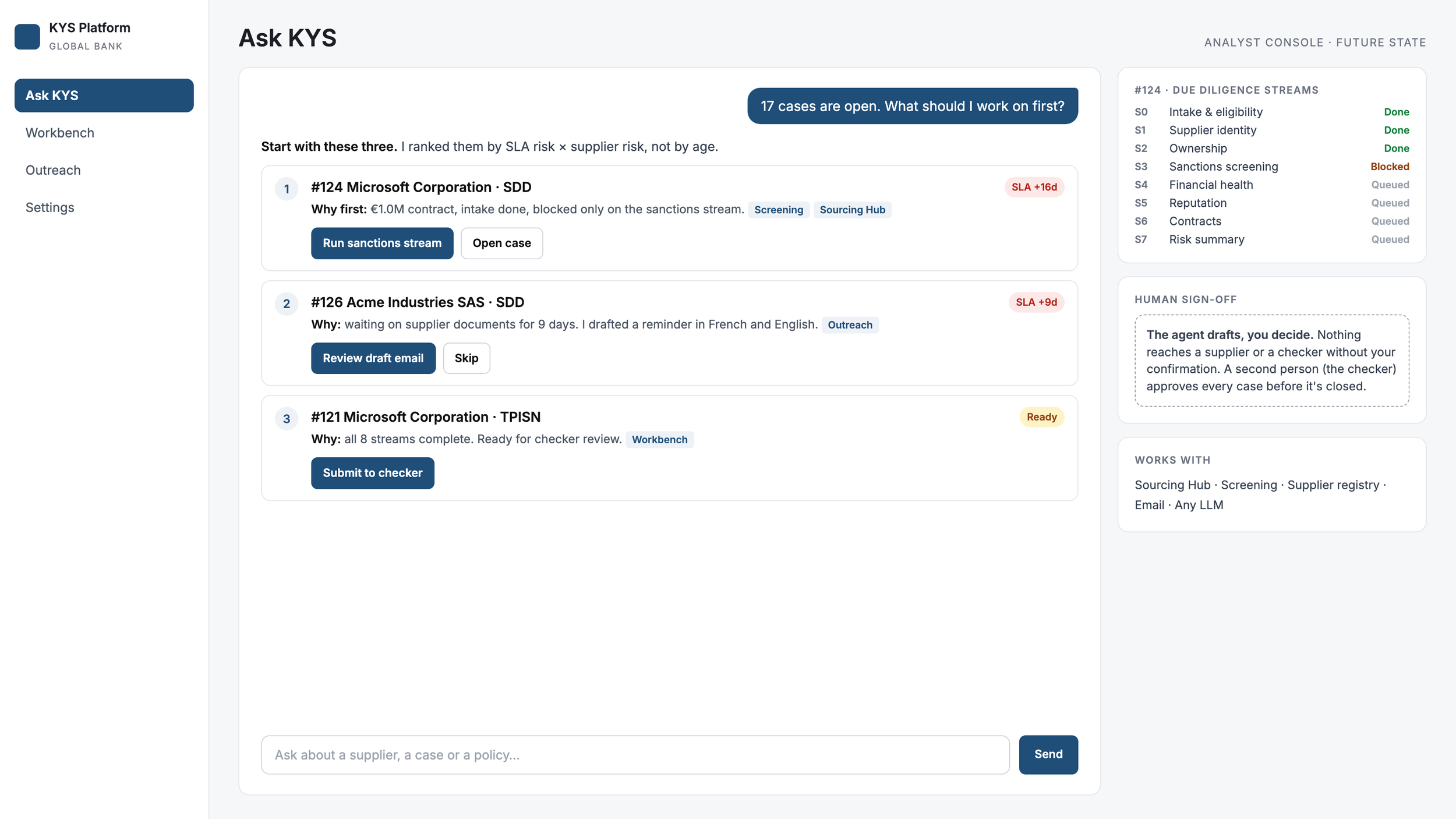
KYS, Know Your Supplier: AI due diligence with a second pair of eyes on every case.
The first bank use case, designed by me and built on phtn.ai. A requester asks for a supplier check and the form fills itself in. An analyst runs agents across 8 due diligence streams. A checker reviews every case before it closes, and a manager watches every agent and every alert that needs a human.
Maker and checker, auditors and data sensitivity are why governance is the product, not an add on.
The marketing site set the style. The product followed. Hierarchy is next.
The launched marketing site at phtn.ai set the visual language: dark, gold, precise. The product restyle adopted it, but 24 widgets still share equal weight.
Next is hierarchy: act on ranked decisions first, then context with targets, then investigate one click down.
Ask what's most important, and why. Get the same answer, in any brand.
One pattern: ranked answers, cited evidence, human sign off and an audit trail. The brand is a theme, not a rebuild.
Concept: hypothetical white label palettes, not clients. Tools: Claude, Figma MCP, Claude Code.
The product isn't live yet. Here's how I'll know it's working.
Time to insight. Decision confidence. Action rate. Chat resolution. Approval rate trend. Time per step and deviations.
Baseline: the 50 audit findings. Who tests it: Photon staff now, then the bank's subject matter experts at launch. Status: research plan written, approval to run it with first customers pending.
What changed because design was in the room.
50 findings turned into a plan leadership acted on. 1 direction adopted: manual, digital, tool agnostic. 5 areas of my design shipped, including a bank app.
In an engineering first culture, a critique only lands when it arrives with a plan, and the next step is small enough to say yes to.